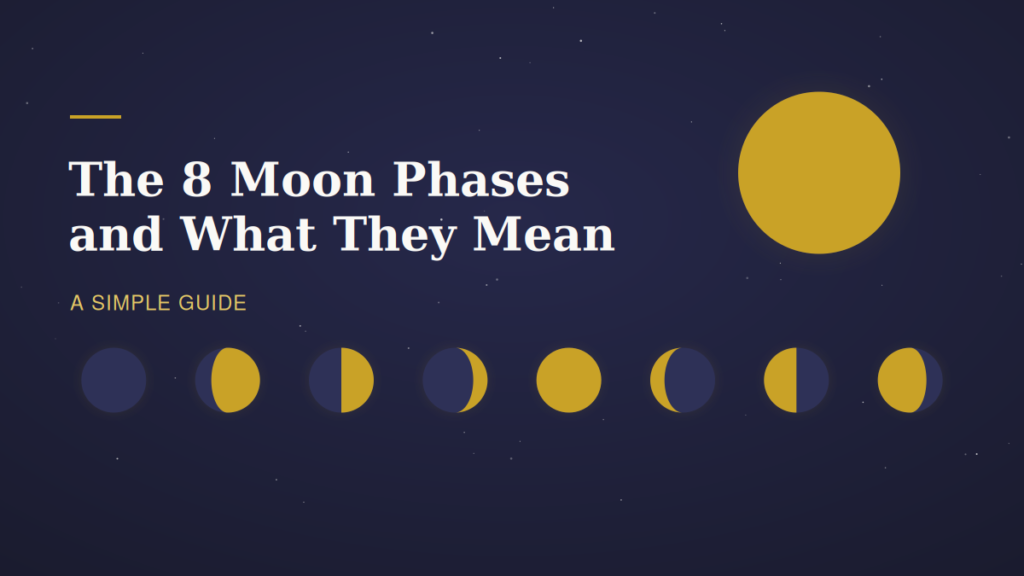
Wondering what are the 8 phases of the moon and what each one means? Here is the whole cycle in plain English: the eight shapes the Moon moves through each month, in order, with what each looks like and the meaning people like to attach to it. No chart or telescope needed.
The Moon takes about 29.5 days to go from one new moon to the next, and along the way it passes through eight named phases. Four are “primary” (new, first quarter, full, third quarter) and four are “intermediate” (the crescents and gibbous phases in between).
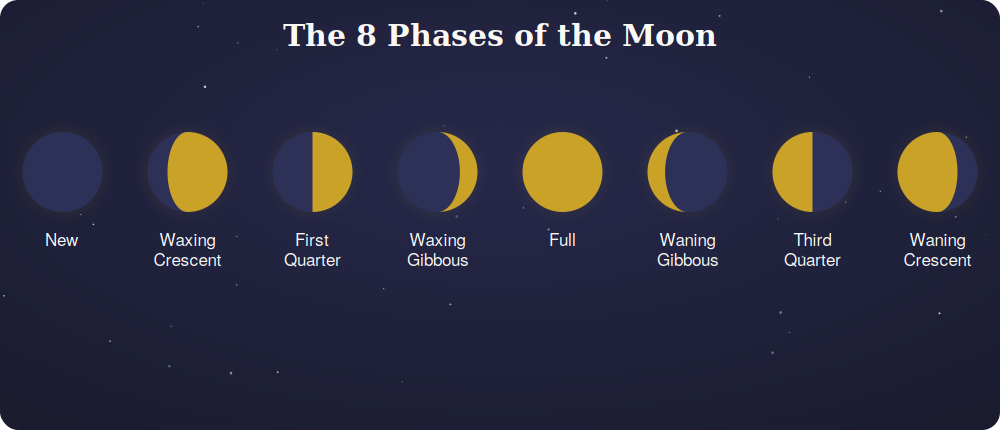
What are the 8 phases of the moon, in order?
- 1. New moon — the Moon sits between Earth and the Sun, so the side facing us is dark. Meaning people attach: fresh starts, intentions, a blank page.
- 2. Waxing crescent — a thin sliver of light on the right begins to grow. Meaning: hope, first steps, building momentum.
- 3. First quarter — half the disc is lit. Meaning: decisions, action, pushing through resistance.
- 4. Waxing gibbous — more than half, filling toward full. Meaning: refining, adjusting, almost there.
- 5. Full moon — the whole face is bright. Meaning: fullness, emotion, things coming to light.
- 6. Waning gibbous — the light starts to shrink. Meaning: gratitude, sharing, giving back.
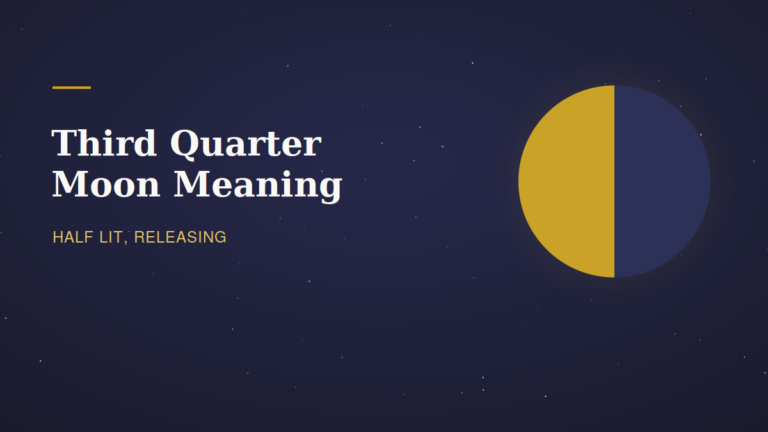
- 7. Third quarter — the other half is lit. Meaning: release, letting go, forgiveness.
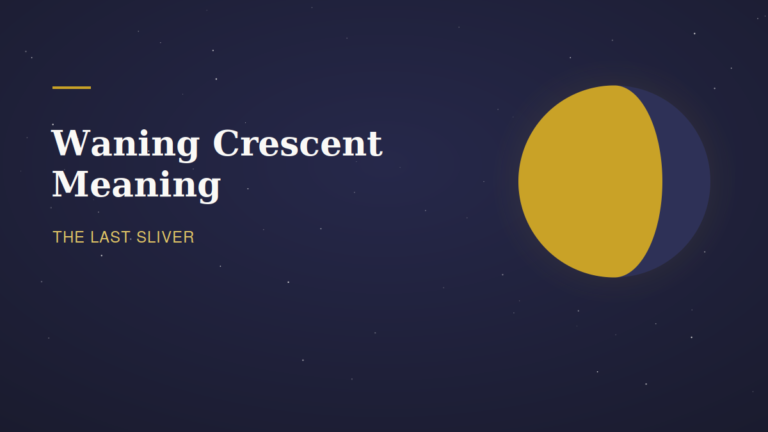
- 8. Waning crescent — a last sliver before the cycle restarts. Meaning: rest, reflection, surrender.
Primary phases vs. intermediate phases
It helps to know the eight split into two groups. The four primary phases — new, first quarter, full, and third quarter — happen at a precise moment in time, when the Sun, Earth, and Moon line up at specific angles. The four intermediate phases — the two crescents and two gibbous phases — are the stretches in between, where the Moon is on its way from one primary phase to the next. So when someone says the Moon is “in” a crescent phase, they mean it is somewhere in that multi-day window, not at a single instant.
How long each phase lasts
The whole cycle runs about 29.5 days, so very roughly each of the eight phases covers around three to four days — though the primary phases (new, quarters, full) are really single moments that we round to a day. That is why a moon can look “basically full” for two or three nights around the actual full moon: you are seeing the tail of the waxing gibbous and the start of the waning gibbous on either side of it.
Waxing vs. waning: the quick rule
Half of those phases are waxing (growing brighter, heading toward full) and half are waning (shrinking, heading toward new). An easy trick in the Northern Hemisphere: if the lit side is on the right, it is waxing; on the left, waning. We go deeper on this in waxing vs. waning moon.
Why the Moon changes shape
The Moon does not actually change shape and it does not make its own light — it reflects the Sun. What changes is how much of its lit half we can see as it orbits Earth. If you want the real astronomy, NASA has a friendly explainer on the phases, and The Old Farmer’s Almanac keeps a live moon phase calendar with the traditional names.
What your birth phase is said to mean
People love matching their birthday to a phase — a new-moon person cast as a starter, a full-moon person as expressive, and so on. It is a fun lens, and it is the whole basis of the moon phase soulmate idea, where two people’s phases are paired up.
An honest note: none of this is science. There is no research showing the Moon’s shape on your birthday shapes your personality or your future. Enjoy it as a bit of fun and self-reflection, not fact.
Find your phase
The quickest way to see which of these eight shapes was in the sky on your birthday is to let the calculator do the date math.
Find your moon phase with the calculator — enter two birth dates and see your moon phase pairing in seconds. It is free, and it is meant to be fun.
Once you know your phase, you can compare it with someone else’s and see how your two shapes line up.