Wondering which pairings the trend loves best? In moon phase couple compatibility, the “most compatible” matches are almost always the opposite phases — a new moon with a full moon, a waxing crescent with a waning crescent — because opposite shapes fit together into one complete cycle. Matching phases come a close second, read as kindred spirits.
Here are the classic pairings, why they are called compatible, and an honest reminder about how these lists actually work.
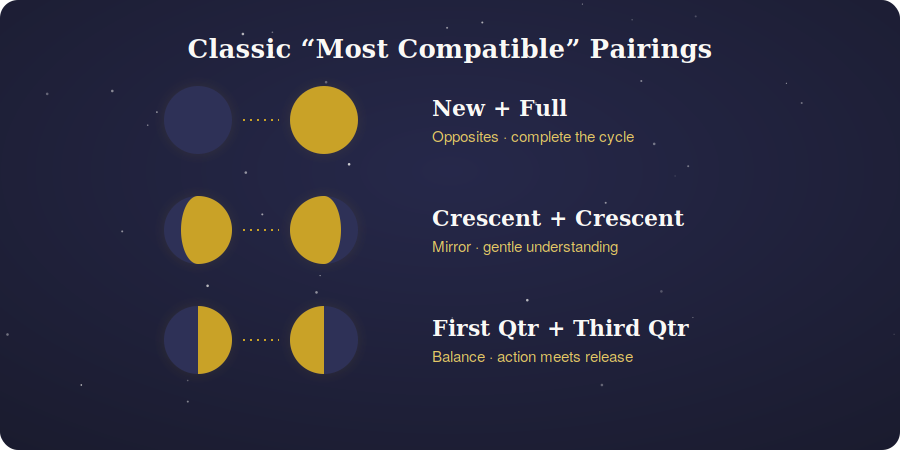
Moon phase couple compatibility: the classic pairings
- New moon + full moon — the headline match: beginnings meet fullness. See why opposites complete each other.
- Waxing crescent + waning crescent — two slivers on opposite sides; gentle, complementary.
- First quarter + third quarter — action meets release; a balancing pair.
- Waxing gibbous + waning gibbous — both near-full, refining and sharing.
- Same phase + same phase — the mirror match; see same moon phase compatibility.
What counts as “compatible” here
It is worth being precise about what these pairings actually measure. Moon phase couple compatibility does not look at your values, your habits, or anything about who you really are — it looks purely at how far apart your two birth phases sit on the cycle. That is it. So when a chart calls new-and-full the “most compatible” pairing, it is really just saying those two phases are farthest apart and therefore complete the cycle most neatly. Understanding that keeps the whole ranking in perspective: it is geometry with a romantic story on top, not a compatibility test in any real sense.
Why opposite phases top the list
Opposite phases win the “most compatible” label because they tell the tidiest story: place a new moon and a full moon side by side and you get a whole cycle in one couple. It is the “you complete me” idea drawn in light and shadow. That is the entire reason these pairings feel special — it is a lovely visual, not a measured fact.
The honest catch about compatibility lists
Here is the part most articles leave out: in these systems, every pairing can be spun as compatible. Opposites “complete” you; same phases “understand” you; in-between phases “balance” you. That is a feature of the trend, not a discovery about you — and a good reason to enjoy the result without taking the ranking too seriously. For more on that, see what moon phase compatibility really means.
An honest note: moon phase compatibility is for entertainment and reflection, not science. No research shows the Moon’s shape on your birthday affects your relationships. Enjoy it as a fun conversation starter, not a verdict.
What about the phases themselves?
If you want to understand the eight shapes behind these pairings, our guide to the 8 moon phases covers each one. And timeanddate.com has a plain explainer of the phases if you want the astronomy. The Old Farmer’s Almanac also keeps a moon calendar for looking up any date.
Don’t chase the “perfect” match
One last thought: it is tempting to treat a “most compatible” list like a shopping guide for partners, but that misses the point entirely. The pairing you already have — whatever it is — is the interesting one, because it is real. A chart cannot tell you whether you laugh at the same things, support each other, or want the same future. So enjoy discovering your pairing, read the flattering story, and then set it aside and go be with the actual person. That is where compatibility really lives. And if you happen not to have a partner yet, there is no need to go hunting for someone with a “compatible” phase — that would be letting a bit of fun make a decision it was never meant to make. The Moon is a nice conversation piece, not a matchmaker.
Find your most compatible match
The fun way to see which pairing you land on is to run two birthdays.
Try the free Moon Phase Soulmate Calculator — enter two birth dates and see your moon phase pairing in seconds. It is free, and it is meant to be fun.
Compare two dates and see where you fall — then take the result with a wink.