Curious what your birth phase says about how you love? The moon phase meaning in a relationship is a fun lens: each of the eight phases is linked to a slightly different way of connecting — how you start, express, and recharge with a partner. It is entertainment, not psychology, but it makes a warm little mirror.
Here is what each birth phase is said to bring to a relationship, and how to use the idea without over-reading it.
Why people look for a moon phase meaning in a relationship
Part of the appeal is that relationships are complicated, and any framework that offers a simple, gentle way to talk about them is welcome. Assigning yourself a “phase” gives you a friendly shorthand — “I’m a new-moon starter, you’re a full-moon expresser” — that can make it easier to laugh about your differences instead of clashing over them. That is genuinely useful, even though the label itself is just for fun. The Moon isn’t steering your love life; it is simply giving you a pleasant, low-pressure vocabulary for talking about it.
Moon phase meaning in a relationship, phase by phase
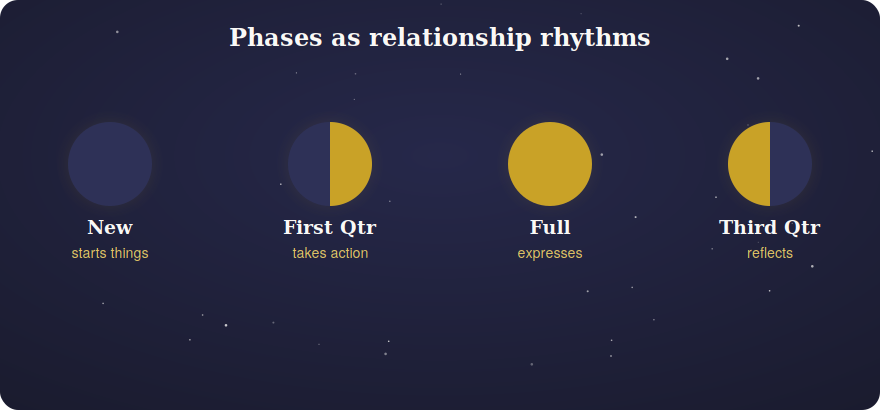
- New moon — the initiator; drawn to fresh starts and quietly setting the tone.
- Waxing crescent — the hopeful builder; nurtures a relationship as it grows.
- First quarter — the doer; faces challenges head-on and pushes things forward.
- Waxing gibbous — the refiner; attentive to the little things that make love work.
- Full moon — the expresser; open, emotional, warm, and visible in love.
- Waning gibbous — the giver; generous, sharing, focused on gratitude.
- Third quarter — the releaser; good at forgiveness and letting go of friction.
- Waning crescent — the reflector; intuitive, gentle, needs quiet to recharge.
How to actually use this
Think of your phase as a conversation starter about your natural “love rhythm.” Maybe you are a new-moon initiator paired with a full-moon expresser — a fun way to talk about who sets plans and who brings the emotion. None of it is fixed or measured; it is a friendly prompt for the kind of chat every couple benefits from. If you are not sure which phase you are, our guide to finding your birth moon phase shows you how.
Phase vs. sign, one more time
Quick reminder: this is about your moon phase (the shape), not your moon sign (the zodiac). They get mixed up constantly — moon phase vs. moon sign untangles them. The relationship “meanings” here all come from the phase.
Keep it light
An honest note: moon phase compatibility is for entertainment and reflection, not science. No research shows the Moon’s shape on your birthday affects your relationships. Enjoy it as a fun conversation starter, not a verdict.
Real relationships run on communication, trust, and effort — not lunar shapes. If a phase “meaning” ever seems to clash with your actual happy relationship, trust the relationship. For the honest take on whether any of this is real, see is moon phase compatibility real? And if you want the astronomy of the phases, NASA has a clear overview, while timeanddate.com breaks down each phase.
Do opposites or matches make better partners?
People often ask whether the trend says opposite-phase couples or same-phase couples do better. The honest answer is that it does not say anything reliable either way — and real life backs that up. Some thriving couples are near-mirror images of each other; others are total opposites who balance one another out. What matters is not which phases you were born under but how you treat each other day to day. If your phases suggest you are opposites, enjoy the “we complete each other” story; if they match, enjoy the “we just get each other” story. Both are lovely, and neither predicts a thing.
See your phase — and your match
Find your birth phase, then compare it with your partner’s for fun.
Try the free Moon Phase Soulmate Calculator — enter two birth dates and see your moon phase pairing in seconds. It is free, and it is meant to be fun.
Run your two birthdays and see how your love rhythms line up.