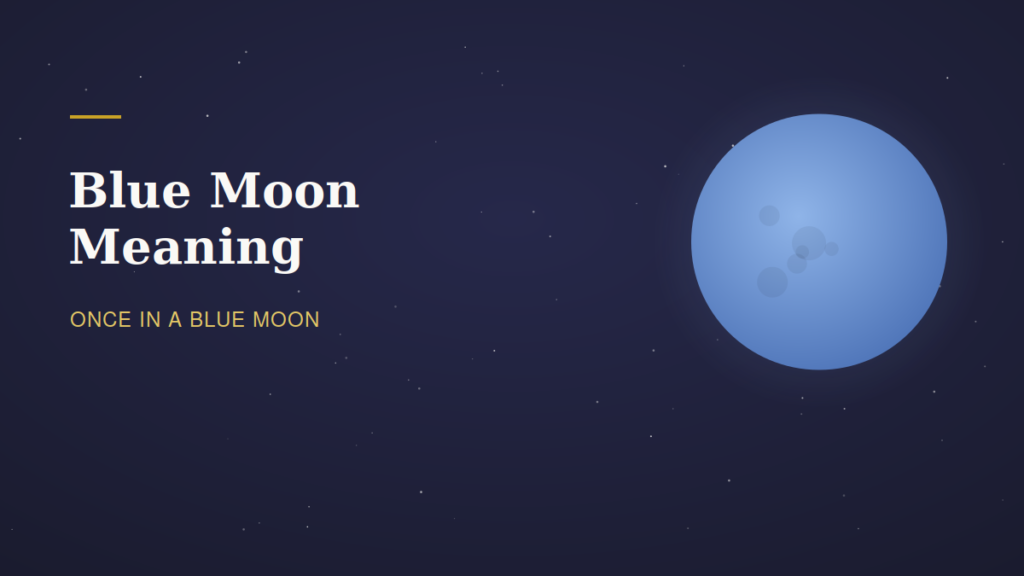
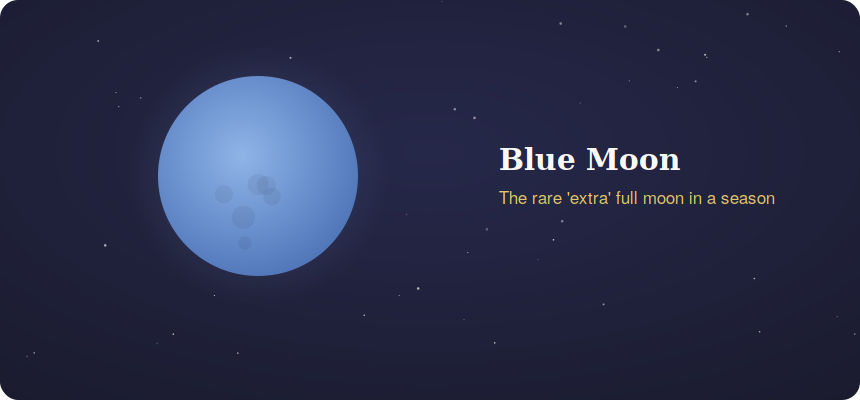
The blue moon meaning has almost nothing to do with color: a blue moon is an extra full moon — a “bonus” full moon that does not fit the usual once-a-month pattern. It is where the phrase “once in a blue moon” comes from, because these extra full moons are relatively rare, happening roughly every two and a half years.
Here is what a blue moon actually is, why it is uncommon, and where the famous saying comes from.
What a blue moon actually is
There are two common definitions, and both describe an “extra” full moon:
- Monthly blue moon — the second full moon in a single calendar month. Since months are a bit longer than the lunar cycle, occasionally two full moons squeeze into one month, and the second is the blue moon.
- Seasonal blue moon — the older, original meaning: the third full moon in a season that has four full moons instead of the usual three.
Either way, a blue moon is simply a full moon that arrives “extra,” because the Moon’s roughly 29.5-day cycle does not divide evenly into our calendar.
Why it’s rare — “once in a blue moon”
Because it takes a while for the lunar cycle and the calendar to drift far enough apart, blue moons only come around every two to three years. That rarity is exactly why “once in a blue moon” became a way of saying “very rarely.” The phrase is centuries old and has long meant something that almost never happens.
Does the moon actually turn blue?
Almost never. A blue moon is about timing, not color. The Moon can rarely look genuinely bluish, but only after events like large volcanic eruptions or wildfires, when particles of a certain size in the atmosphere scatter light in a way that tints the Moon — and that is unrelated to the calendar meaning. For the everyday blue moon, the Moon looks its normal self.
A quick, honest note: the “spiritual meanings” below are folklore and popular belief, not science or fact. They are lovely traditions to enjoy, not claims we can prove. We share them as culture and entertainment.
Blue moon meaning: what it’s said to represent
Because it is an extra, rare full moon, popular belief treats the blue moon as a time of rare opportunity, heightened intuition, or a “bonus” chance to set intentions — essentially a full moon with a little extra significance attached. These are traditions and beliefs rather than facts, but they are part of why blue moons capture the imagination.
How often does a blue moon happen?
On average, a blue moon comes around once every two to three years, though the exact timing depends on which definition you use and how the full moons happen to fall. Monthly blue moons (two full moons in one calendar month) and seasonal blue moons (the third of four in a season) do not line up, so their dates differ. Every so often a single year can even contain two blue moons, while other stretches go longer than three years without one — which only adds to the “once in a blue moon” feeling. timeanddate.com keeps a clear reference on moon names and events if you want to look up upcoming ones.
A quick, honest note: the “spiritual meanings” below are folklore and popular belief, not science or fact. They are lovely traditions to enjoy, not claims we can prove. We share them as culture and entertainment.
Where the blue moon fits
The blue moon is a special case that sits alongside the regular named full moons of the calendar. If you want to check when the next blue moon falls, The Old Farmer’s Almanac keeps a moon calendar that lists them.
Find your own moon phase
Ever wondered what the Moon was doing on your birthday — blue moon or otherwise?
Find your birth moon phase — enter two birth dates and see your moon phase pairing in seconds. It is free, and it is meant to be fun.
Run your date, or compare yours with a friend’s for fun.