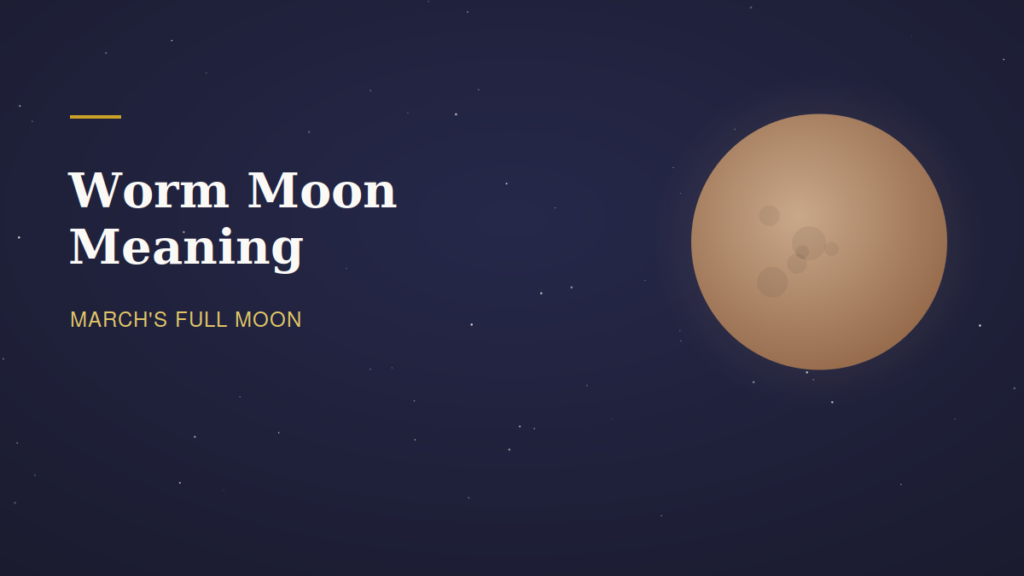
The worm moon meaning marks the turn from winter to spring: the worm moon is March’s full moon, traditionally linked to the softening, thawing ground at winter’s end. It is usually the last full moon of winter, and often falls close to the spring equinox — making it a genuine marker of the seasons changing.
Here is where the name comes from, an interesting twist in its origin story, and what the worm moon is said to represent.
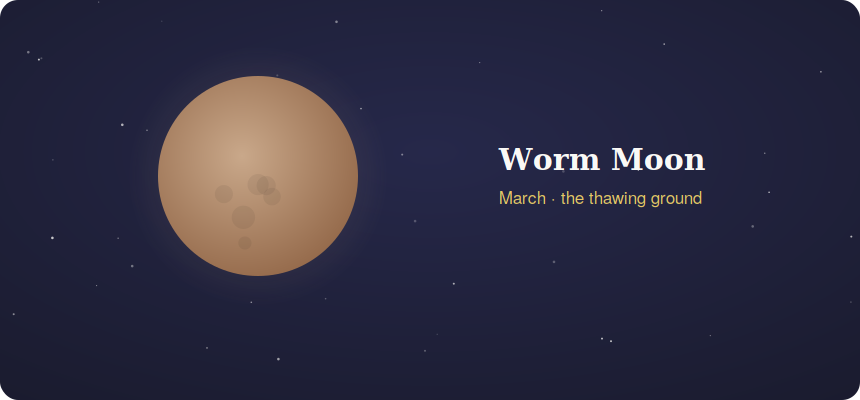
Worm moon meaning: the name and a surprising twist
The earthworm explanation
The familiar explanation is that as March’s ground thaws, earthworms emerge from the soil — a sign that spring is coming and planting will soon be possible. That is the version most people know.
The beetle-larvae explanation
But there is a lesser-known twist worth mentioning. Later research pointed to an account by Captain Jonathan Carver, who visited the Naudowessie (Dakota) people in the 1700s and recorded that the name referred not to earthworms but to beetle larvae emerging from the thawing bark of trees. Both explanations are tied to the same idea — life stirring again as the freeze ends — but the beetle-larvae origin is the more historically documented one. We mention both because the honest answer is that the name has more than one story behind it.
Other names for the March full moon
- Sap Moon or Sugar Moon — for the tapping of maple trees as the sap runs.
- Crow Moon — for the cawing of crows signalling winter’s end.
- Lenten Moon — an older European name tied to the church calendar.
- Crust Moon — for snow that thaws by day and refreezes into a crust at night.
Every one of these names describes the same thing from a different angle: the specific, recognisable texture of late winter turning to spring. The Old Farmer’s Almanac full moon names guide has more.
Worm moon meaning in folklore and belief
The worm moon meaning people attach to it today is all about waking up. In popular belief, the worm moon is associated with renewal, emergence, fresh starts, and coming out of a difficult period — the feeling of life returning after winter. Some treat it as a time to shake off stagnation and begin again. These are traditional and symbolic associations rather than facts, but they suit the season’s mood well.
An honest note: the “spiritual meanings” below are folklore and popular belief, not science or proven fact. They are lovely traditions to enjoy, not claims we can verify. We share them as culture and entertainment.
The worm moon and the spring equinox
March’s full moon often falls near the spring equinox, which adds to its “turning point” feeling. In some years the worm moon is the last full moon of winter; in others it lands just after the equinox and becomes the first of spring. It also plays a role in setting the date of Easter, which is calculated from the first full moon after the equinox. timeanddate.com’s moon phase calendar shows the exact dates for any year.
Watching the worm moon
March is a good month for moon-watching precisely because the weather is shifting. Skies are often clearer than in midwinter, evenings are getting longer, and it is finally comfortable enough to stand outside for a few minutes without freezing. Look east around sunset on the night of the full moon. If there is still snow or frost on the ground, the reflected light can make the whole landscape unusually bright — one of the quiet pleasures of a late-winter full moon.
Where the worm moon fits
The worm moon follows February’s Snow Moon and comes before April’s Pink Moon. See the whole cycle in our guide to full moon names, or read about January’s Wolf Moon.
Born under a worm moon?
If your birthday falls near March’s full moon, see what being born on a full moon is said to mean.
Find your birth moon phase — enter a birth date and see the moon phase in seconds. It is free, and it is meant to be fun.
Check your date and find your birth moon phase.