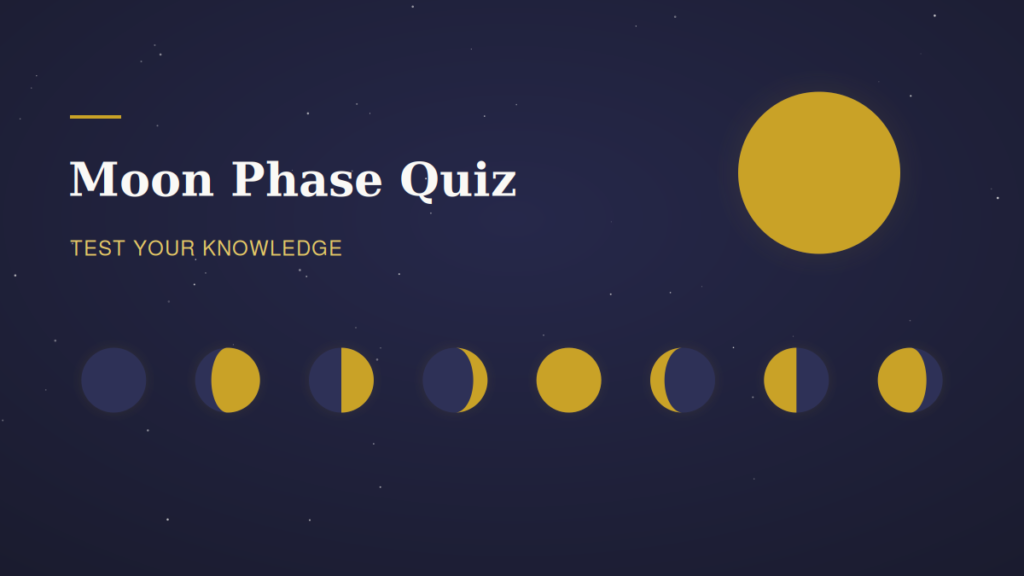
Think you know your waxing crescent from your waning gibbous? This quick moon phase quiz tests your knowledge of the eight lunar phases, how the cycle works, and the tricks for telling them apart. Answers are at the bottom — no scrolling ahead.
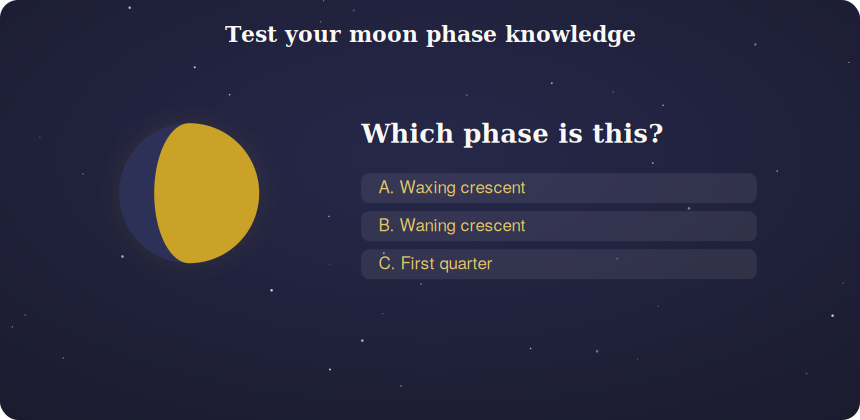
The moon phase quiz
Questions 1–10
1. How many named phases are in one lunar cycle?
2. Roughly how many days does a full lunar cycle take?
3. Does “waxing” mean the lit part is growing or shrinking?
4. In the Northern Hemisphere, which side is lit during a waxing moon?
5. Which phase comes immediately after the full moon?
6. During a new moon, why can’t we see the Moon?
7. What is the phase called when exactly half the disc is lit and the light is growing?
8. Does the Moon produce its own light?
9. What is a “gibbous” moon?
10. Is the moon phase the same for everyone on Earth on a given night?
The answers
Answers to questions 1–10
- Eight — new, waxing crescent, first quarter, waxing gibbous, full, waning gibbous, third quarter, waning crescent.
- About 29.5 days from one new moon to the next.
- Growing. Waxing means increasing; waning means decreasing.
- The right side. Lit on the right means waxing; lit on the left means waning. This flips in the Southern Hemisphere.
- Waning gibbous — the light has just started to shrink.
- The Moon sits between Earth and the Sun, so the side facing us is unlit.
- First quarter. (Third quarter is the half-lit phase on the way back down.)
- No — it reflects sunlight. It makes no light of its own.
- Any phase where more than half but not all of the disc is lit.
- Yes. Everyone on Earth sees the same phase on the same night, though the orientation looks different from the Southern Hemisphere.
Bonus round: three harder ones
11. Why does the same phase look “upside down” from Australia compared with Canada?
12. What is a blue moon?
13. Why is the harvest moon useful to farmers?
Answers: 11. Because Southern Hemisphere observers are effectively viewing the Moon from an inverted vantage point, so the lit side appears on the opposite edge. 12. An “extra” full moon — commonly the second in a calendar month, originally the third in a season with four. 13. Around the autumn equinox it rises only about 25–30 minutes later each night instead of the usual 50, giving several evenings of bright light soon after sunset.
How did you do on the moon phase quiz?
- 8–10 correct — genuinely impressive; you know the cycle.
- 5–7 correct — solid grasp, a few details to firm up.
- Under 5 — no shame at all; most people have never had reason to learn this.
Why these questions trip people up
Two of these catch almost everyone. The waxing/waning direction is the classic stumbling block, because there is no intuitive reason the lit side should be on the right when growing — you simply have to learn it (and remember it reverses south of the equator). The other common miss is question eight: plenty of people know the Moon reflects sunlight but still picture it glowing faintly on its own. Neither gap is a failure of intelligence; they are just facts most of us were taught once at school and never needed again.
Brush up on the phases
If this moon phase quiz caught you out on a few, our guide to the 8 moon phases and what they mean walks through each one, and waxing vs waning moon covers the single most useful distinction. For the real astronomy, NASA has a clear moon phases overview and timeanddate.com breaks down each phase in turn.
Now find your own phase
Knowing the eight phases is one thing — knowing which one was overhead when you were born is more fun. It takes a single date, and it is the detail most people never think to look up about their own birthday.
Find the moon phase you were born under — enter two birth dates and get your result in seconds. It is free, no sign-up, and it is meant to be fun.
You can also read how to work out your birth moon phase step by step, or compare your phase with a friend’s to see how the two line up.