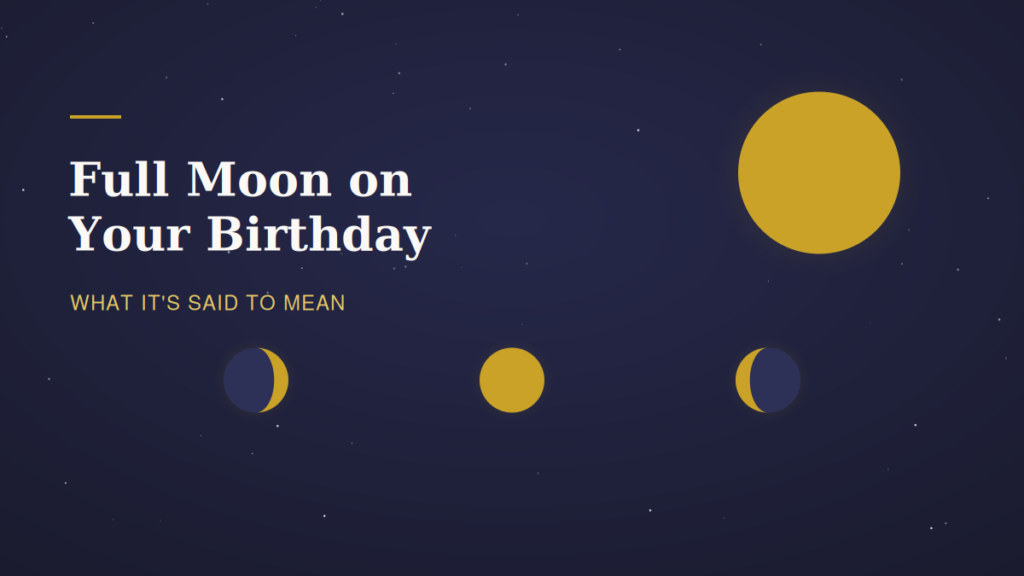
Having a full moon on your birthday is one of those small, pleasing coincidences that feels like it ought to mean something. In folklore it is linked to being expressive, open, and comfortable being seen — because the full moon is the brightest, most visible point of the lunar cycle. Here is how rare it actually is, what the tradition says, and how to check your own date.
How rare is a full moon on your birthday?
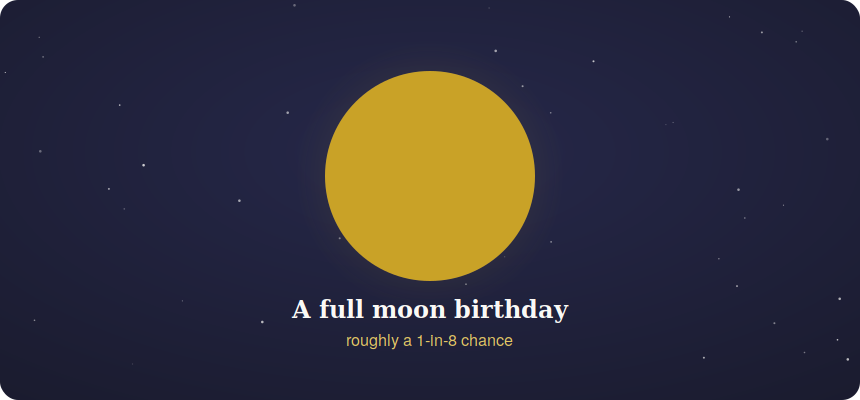
Less rare than it sounds. There are eight named phases, so loosely speaking any given birthday has roughly a one-in-eight chance of landing on a full moon — and if you count the nights either side when the Moon still looks essentially full, the odds improve further. If you mean the exact moment of the full moon falling on your birth date, it is rarer. Either way, it is a nice coincidence rather than a cosmic rarity, and there is no need to inflate it to enjoy it. You can look up the phase for any past date on timeanddate.com’s moon phase calendar and check for yourself.
Which full moon was it?
If you were born on a full moon, that moon also had a traditional name depending on the month — the Wolf Moon in January, the Strawberry Moon in June, the Beaver Moon in November, and so on. It is a small extra detail that makes the coincidence feel more specific. The Old Farmer’s Almanac keeps a moon calendar listing them, and our guide to full moon names covers all twelve.
What a full moon birthday is said to mean
The traditional reading casts full-moon people as:
- Expressive — feelings tend to show rather than hide.
- Warm and sociable — comfortable being seen and connecting with others.
- Emotionally attuned — big feelings, sometimes intense ones.
- Drawn to culmination — the sense that things come to a head around them.
These are symbolic associations built on the imagery of a bright, full Moon — not measured traits. Take the parts that fit and shrug off the rest. Our companion piece on what it means to be born on a full moon goes deeper.
An honest note: this is for entertainment, not science. No research shows the Moon’s shape on your birthday affects your personality or relationships. Enjoy the result as a conversation starter, not a verdict.
What it means for compatibility
In the moon phase compatibility trend, a full-moon birthday is one half of the most famous pairing: full moon with new moon, cast as opposites who complete each other. If your partner was born under a new moon, the trend will call that a classic match — see new moon and full moon compatibility. If they were also born under a full moon, that is a mirror match instead: same moon phase compatibility.
The myth worth debunking
You will often see the claim that more babies are born on a full moon. Large studies have found no reliable link between the full moon and birth rates. So a full moon birthday is a coincidence, not evidence of anything — and we would rather tell you that than repeat a tidy myth.
What if it was not quite a full moon?
Many people check their date and find they were born a day or two off the exact full moon — landing on a waxing or waning gibbous instead. That is still a bright, nearly-full Moon, and to the naked eye it would have looked full. If you like the full-moon reading, there is no harm in claiming it; if you would rather be precise, the gibbous phases have their own associations around refining and sharing. Either way you now know something specific about the night you arrived.
Is it lucky?
Plenty of traditions treat it as special, and if that brings you a smile, enjoy it. But it does not make anyone luckier or more anything. It is simply a charming detail about the night you were born, and a good story at a birthday dinner.
Check your own birthday
Not sure whether you actually had a full moon on your birthday? It takes one date to find out.
Check your birth moon phase — enter two birth dates and get your result in seconds. It is free, no sign-up, and it is meant to be fun.
Then compare it with someone else’s to see how your phases pair up.