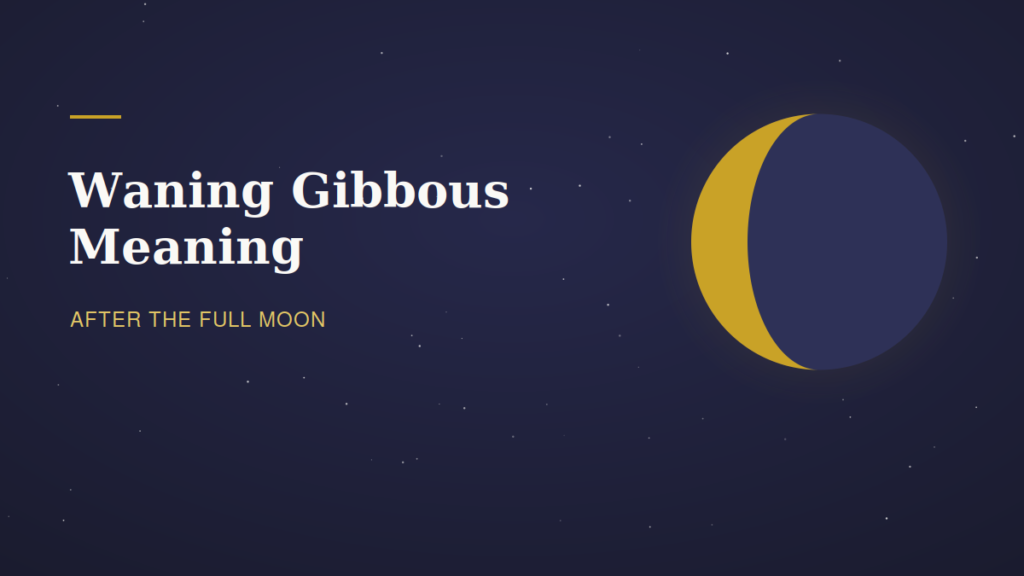
The waning gibbous meaning starts with a simple definition: it is the phase that begins immediately after the full moon, when the lit part of the Moon shrinks from about 100% back down to 50%. “Waning” means shrinking and “gibbous” describes the rounded, more-than-half shape — so a waning gibbous is a fat, shrinking Moon.
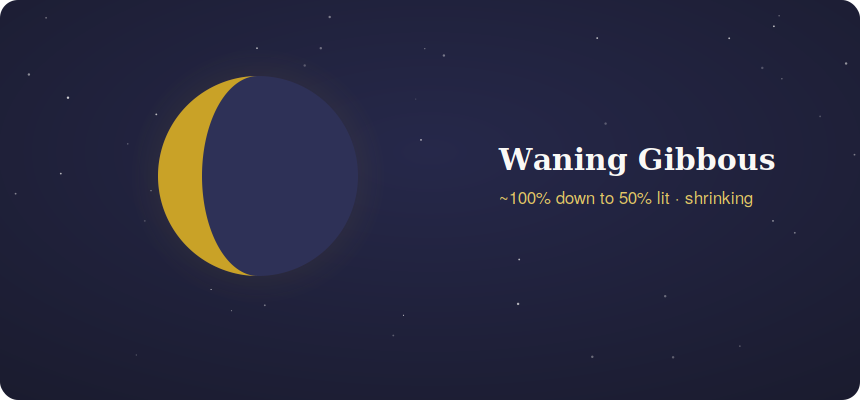
What a waning gibbous moon looks like
More than half the disc is lit, but noticeably less than full, and the lit portion gets smaller each night. In the Northern Hemisphere the light sits on the left side. In the first night or two it can be genuinely hard to tell apart from a full moon — at 98–99% illumination the difference is subtle, as timeanddate.com notes in its waning gibbous guide.
Where it sits in the cycle
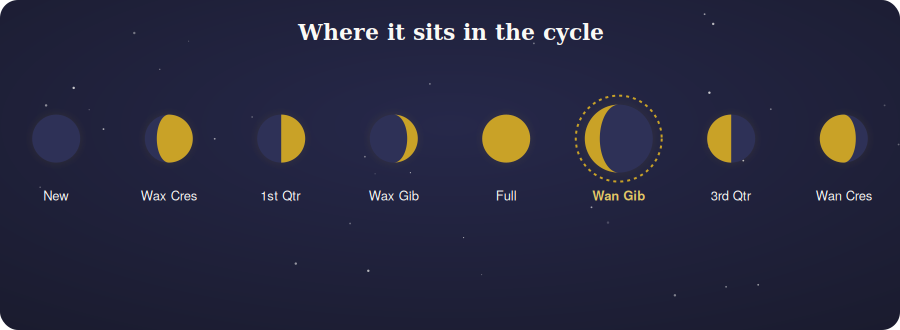
The waning gibbous is the sixth of the eight phases, sitting between the full moon and the third quarter. Britannica’s overview of lunar phases places it in the standard sequence: new, waxing crescent, first quarter, waxing gibbous, full, waning gibbous, last quarter, waning crescent.
How long does it last?
Roughly a week. The gibbous and crescent phases each stretch across several days, unlike the new, quarter, and full moments which are precise instants. So if you were born under a waning gibbous, you shared it with everyone born across that whole stretch.
When you can see it
This is the phase you often catch in the morning. A waning gibbous typically rises after sunset but before midnight, and it is still up after sunrise — which is why you sometimes see a big pale Moon in a blue daytime sky. EarthSky’s guide to understanding moon phases explains why rise and set times shift through the cycle.
Waning gibbous meaning in folklore
In popular belief, the waning gibbous is associated with gratitude, sharing, giving back, and reflecting on what has just come to fruition — the idea being that the peak (the full moon) has passed and now is the time to distribute and appreciate rather than chase. Some describe people born under it as generous, thoughtful, and inclined to teach or give away what they have learned.
An honest note: the personality and “spiritual” readings below are folklore and popular belief, not science. The astronomy is real; the meanings are for entertainment.
Waning gibbous vs waxing gibbous
Both are fat, rounded Moons more than half lit, so telling them apart matters. The distinction is direction, and the quickest tell is which side glows. In the Northern Hemisphere a waning gibbous is lit on the left and getting smaller each night; a waxing gibbous is lit on the right and getting bigger. If you cannot remember which is which, the timing helps: waxing gibbous shows up in the early evening before the full moon, while waning gibbous is the one still hanging around in the morning sky afterwards. Watching across two nights settles it instantly — if the lit part shrank, it is waning.
Waning gibbous and the rest of the cycle
It helps to see the waning gibbous as part of a downhill run. The full moon marks the peak; then comes the waning gibbous, then the third quarter at half-lit, then the waning crescent, and finally the new moon and the whole thing starts again. Everything after the full moon is about decreasing light. That single fact is enough to place any Moon you see in the sky within a few days.
Born under a waning gibbous?
If this is your birth phase, the trend casts you as the giver of the cycle. In moon phase compatibility, your natural opposite is the waxing crescent — the phase on the other side of the cycle. You can read how those pairings work in what moon phase compatibility means, and see all eight in the 8 moon phases guide.
Waning gibbous meaning: a quick recap
To pull it together: the waning gibbous meaning is simply a Moon more than half lit and shrinking, sitting between the full moon and the third quarter, lasting about a week, and visible late at night and into the morning. In folklore it stands for gratitude and giving back. The astronomy is solid and checkable; the meaning is a story people have layered on top, and it is best enjoyed that way.
Find your own phase
Not sure whether the waning gibbous is yours?
Find your birth moon phase — enter a birth date and see the phase in seconds. Free, no sign-up, and meant to be fun.
Then compare it with someone else’s, or read up on waxing vs waning.