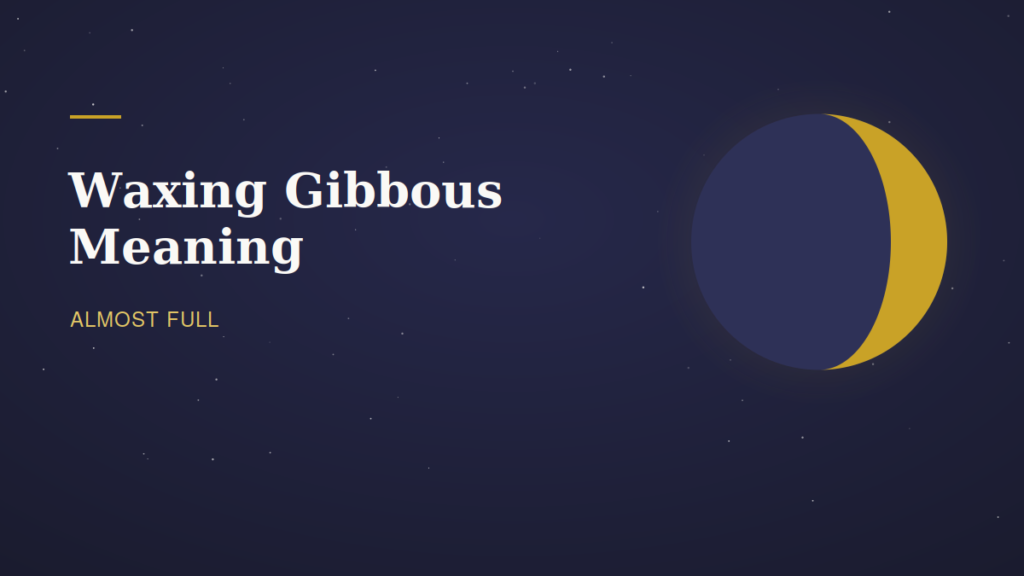
The waxing gibbous meaning is best understood by its two words: “waxing” means the lit part is growing, and “gibbous” means more than half but not yet full. So the waxing gibbous is the almost-full Moon on its way up — the last stretch before the full moon arrives.
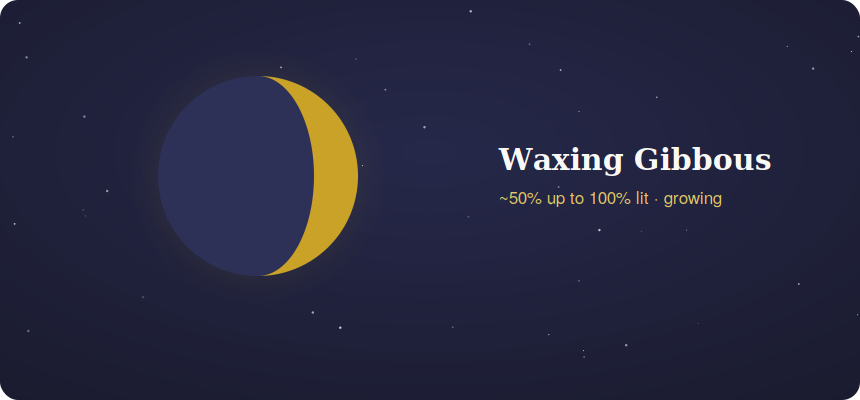
What a waxing gibbous moon looks like
Between about 50% and 100% illuminated, growing brighter each night, with the lit side on the right in the Northern Hemisphere. The word “gibbous” itself is worth knowing: as National Geographic explains in its phases guide, it comes from the Latin for “hump,” long used to describe rounded or convex shapes.
Where it sits in the cycle
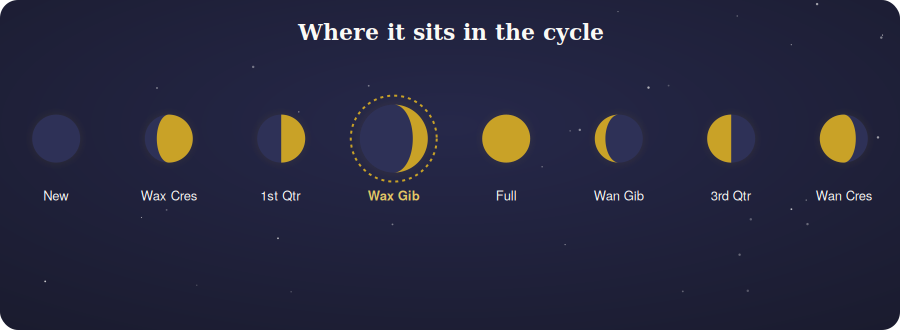
It is the fourth phase, falling between the first quarter and the full moon. Britannica’s entry on the waxing gibbous moon places it in that standard eight-phase sequence.
When you can see it
This is the easiest phase to catch, and a good one for casual moon-watching. A waxing gibbous is already up in the sky before darkness falls and lights the early evening — as EarthSky puts it in their waxing gibbous guide, it appears more than half lighted but less than full, and it dominates the early-evening sky. No late night required.
How long does it last?
About a week, like the other intermediate phases. The full moon and quarters are precise moments; the gibbous and crescent stretches are multi-day windows, which is why so many birthdays fall under them.
Waxing gibbous meaning in folklore
In popular belief, the waxing gibbous is linked to refinement, patience, and final adjustments — the sense of being nearly there and putting in the last effort before something completes. People born under it are often described as detail-oriented, persistent, and good at seeing things through the unglamorous final stretch.
An honest note: the personality and “spiritual” readings below are folklore and popular belief, not science. The astronomy is real; the meanings are for entertainment.
Waxing gibbous vs waning gibbous
These two look similar and get mixed up constantly. Both are more than half lit and rounded; the difference is which direction they are heading and which edge is bright. A waxing gibbous is lit on the right in the Northern Hemisphere and grows each night toward the full moon. A waning gibbous is lit on the left and shrinks away from it. The other useful clue is when you see it: a waxing gibbous is prominent in the evening sky, whereas a waning gibbous is the one still visible after sunrise.
A good phase for moon-watching
If you want to actually look at the Moon rather than just read about it, the waxing gibbous is a practical choice. It is bright and easy to find, it is up at a sociable hour, and unlike the full moon it still has a visible terminator — the line between light and dark — where craters throw long shadows and surface detail stands out. A full moon, by contrast, is lit head-on and looks surprisingly flat through binoculars. Astronomers often prefer the days either side of full for exactly this reason.
Born under a waxing gibbous?
If this is your phase, the trend casts you as the refiner. Your cycle opposite is the waning crescent. For how the pairings work, see moon phase compatibility meaning, or browse all eight phases.
Waxing gibbous meaning: a quick recap
In short: the waxing gibbous meaning describes a Moon that is more than half lit and still growing, sitting between the first quarter and the full moon, lasting roughly a week, and dominating the early-evening sky. In folklore it represents refinement and the final push before completion. The shape and timing are real astronomy; the personality reading is folklore, and worth holding lightly.
Find your own phase
One birth date is all it takes.
Find your birth moon phase — enter a birth date and see the phase in seconds. Free, no sign-up, and meant to be fun.
Then compare with a partner or friend to see how your phases pair up.