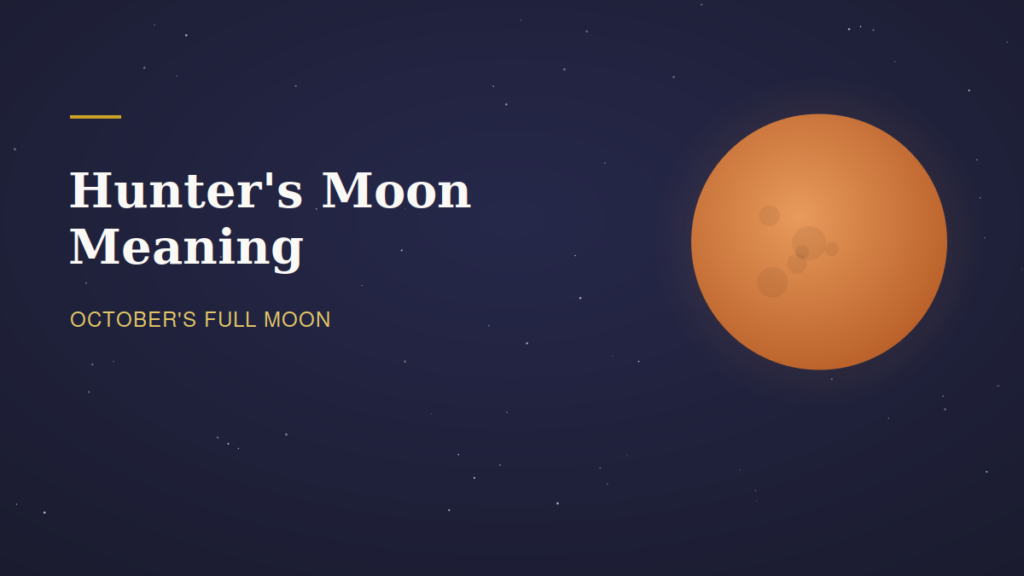
The hunters moon meaning comes from what followed the harvest: the hunter’s moon is the full moon right after the harvest moon — usually October’s — and it is named for the season of hunting and stocking up before winter. With fields cleared and bright moonlight in the early evening, it was a practical time to hunt.
Here is where the name comes from, how it connects to the harvest moon, and what the hunter’s moon is said to represent.
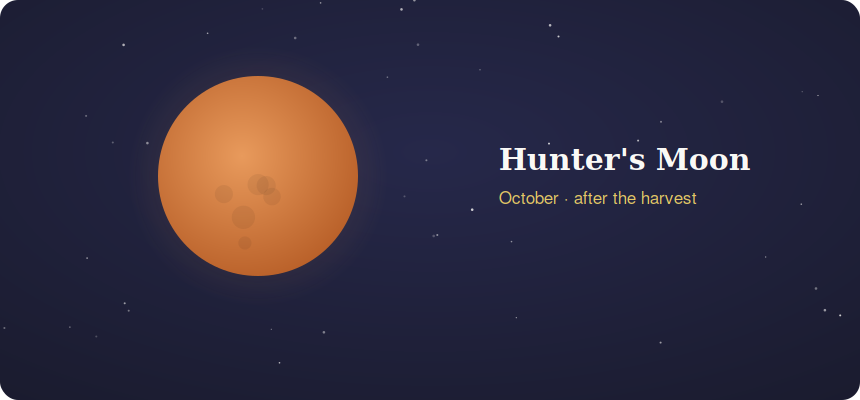
Hunters moon meaning: where the name comes from
After the harvest was gathered, the fields stood bare — making game animals easier to spot. At the same time, this full moon shares the harvest moon’s useful habit of rising soon after sunset for several nights running, giving bright early-evening light. For communities preparing for winter, that combination made it the natural time to hunt and lay in supplies, and the name stuck.
How the hunter’s moon relates to the harvest moon
The two are a seasonal pair, and they are defined by sequence rather than by month:
How the two are defined
- The Harvest Moon is the full moon closest to the autumn equinox — usually September, sometimes October.
- The Hunter’s Moon is simply the next full moon after it — usually October, but November when the harvest moon lands in October.
So in most years it is October’s full moon, but not always. That shifting definition is the same quirk that gives us the Corn Moon in years when the harvest moon moves to October.
Other names for the October full moon
- Blood Moon or Sanguine Moon — older names linked to hunting and the autumn slaughter (not to be confused with the modern “blood moon” used for a lunar eclipse).
- Dying Grass Moon — for the fading vegetation of late autumn.
- Falling Leaves Moon and Freezing Moon — names from various northern peoples.
timeanddate.com lists more variants on its full moon names page.
Hunters moon meaning in folklore and belief
The hunters moon meaning carried forward today is about readiness and follow-through. In popular belief, the hunter’s moon is associated with preparation, focus, provision, and gathering what you need before a lean season — the follow-through after the harvest. Some treat it as a time to take stock and make sure you are ready for what is ahead. These are traditional associations rather than proven facts, but they carry a satisfying sense of purpose.
An honest note: the “spiritual meanings” below are folklore and popular belief, not science or proven fact. They are lovely traditions to enjoy, not claims we can verify. We share them as culture and entertainment.
Why it can look big and orange
The hunter’s moon often appears large and coppery as it rises, which adds to its reputation. That is an ordinary optical effect, though — any full moon low on the horizon is seen through more of Earth’s atmosphere, which scatters shorter wavelengths and leaves the warmer tones. It is not unique to October, but autumn’s clear evenings make it especially noticeable. The Old Farmer’s Almanac full moon names guide has more on October’s moon.
A good moon for actually going outside
Of all the full moons, the hunter’s moon may be the most pleasant to watch. October evenings are usually crisp and clear rather than hazy, it rises early enough that you do not have to stay up late, and the bright early-evening light lingers for several nights running rather than just one. If you have been meaning to pay attention to a full moon and never quite got around to it, this is the easy one to catch — step outside shortly after sunset in mid-to-late October and look east.
Where the hunter’s moon fits
It sits between September’s Harvest Moon and November’s Beaver Moon. See the full year in our guide to full moon names.
Born under a hunter’s moon?
If your birthday falls near October’s full moon, see what being born on a full moon is said to mean.
Find your birth moon phase — enter a birth date and see the moon phase in seconds. It is free, and it is meant to be fun.
Run your birthday and find your birth moon phase.