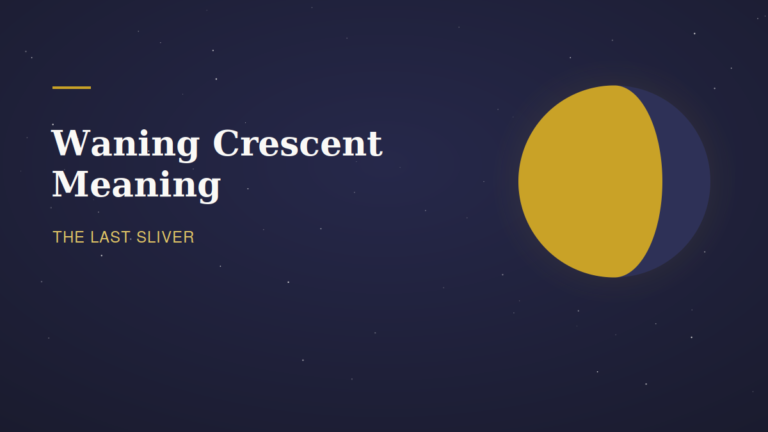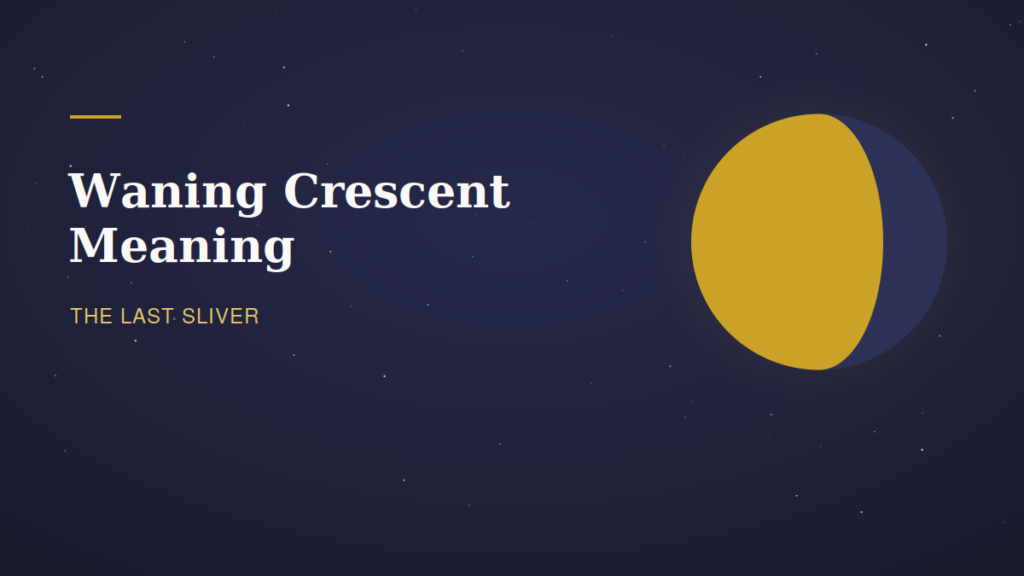
The waning crescent meaning is the story of the cycle winding down: it is the last thin sliver of light before the new moon, shrinking a little each night until the Moon disappears entirely. Less than half is lit, and the lit part is decreasing — the mirror image of the waxing crescent at the start.
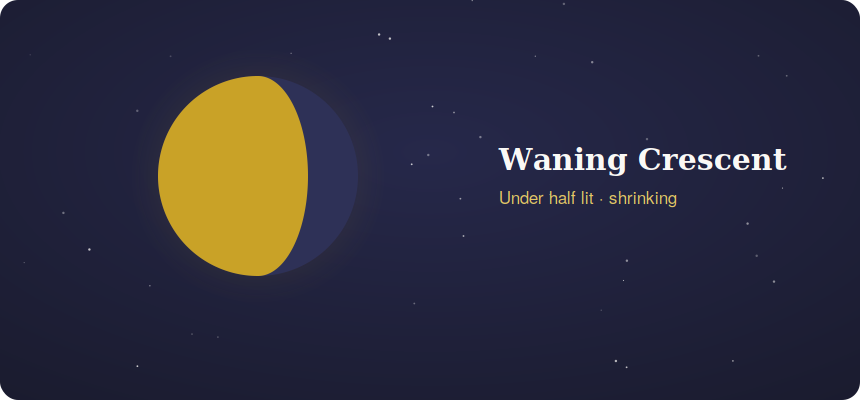
What a waning crescent looks like
A slim curve, lit on the left side in the Northern Hemisphere, somewhere under 50% and getting thinner. That left-side lighting is the quickest way to tell it apart from a waxing crescent, which is lit on the right.
Where it sits in the cycle
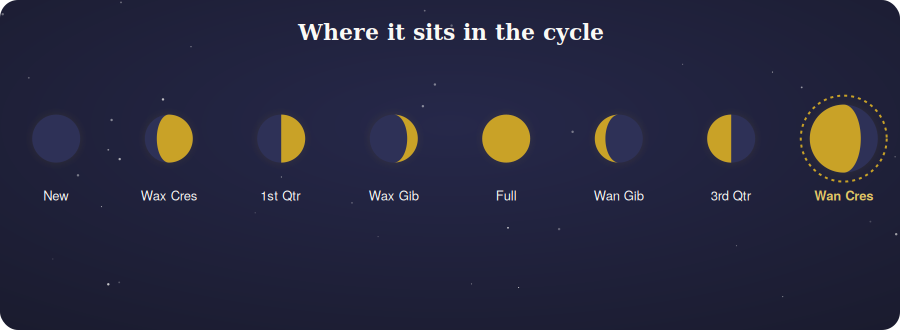
It is the eighth and last phase, running from the third quarter to the new moon — the closing stretch before everything begins again.
When you can see it (look in the morning)
This is the phase most people miss, because it belongs to the early morning rather than the evening. A waning crescent rises in the small hours and is visible in the eastern sky before and around sunrise. As Space.com notes in its phases guide, the waning crescent is the final stage before the Moon returns to its new moon starting position. If you are ever up early, look east — a thin crescent low in a brightening sky is a genuinely lovely sight.
Earthshine returns
Like the waxing crescent, a thin waning crescent often shows earthshine: the unlit part of the disc glowing faintly, lit by sunlight bouncing off Earth. It is easiest to see when the crescent is thinnest, which means the mornings just before a new moon are the best time to look. EarthSky’s primer on moon phases is a clear guide to what is visible when.
Waning crescent meaning in folklore
In popular belief, the waning crescent is linked to rest, release, surrender, and clearing space before something new — the exhale at the end of a cycle. People born under it are often described as reflective, intuitive, and comfortable with endings and letting go.
An honest note: the meanings below are folklore and popular belief, not science. The astronomy is real and checkable; the symbolism is for entertainment.
Why it marks the end of the cycle
The waning crescent is the closing act. After it, the Moon slips into the new moon and the whole sequence restarts — which is why so much of the folklore around it deals with endings and preparation for beginnings rather than with the endings themselves. In lunar calendars the disappearance of this final sliver was a practical signal that the month was nearly over, so its association with completion has a genuinely functional origin rather than a purely symbolic one.
Waning crescent vs waxing crescent
Both are thin slivers, and they are easy to mix up. Three tells: the waning crescent is lit on the left, appears in the morning sky, and is getting smaller. The waxing crescent is lit on the right, appears in the evening sky, and is getting bigger. If you are unsure, note the time of day you saw it — that alone usually answers it.
Born under a waning crescent?
The trend casts you as the one who completes and releases, with the waxing gibbous as your cycle opposite. See how the pairings work or browse all eight phases. You can check any date against The Old Farmer’s Almanac moon calendar.
Waning crescent meaning: a quick recap
In short: the waning crescent meaning describes the final thin, shrinking sliver before the new moon, lit on the left, best seen in the eastern sky before dawn. In folklore it stands for rest and release — the natural close of a cycle.
Waning crescent and the calculator
If the waning crescent is your birth phase, the moon phase compatibility trend gives you the waxing gibbous as your opposite number — the refiner paired with the releaser. Whether that resonates is entirely up to you, but it is the sort of detail that makes a good conversation starter when you run two birthdays together.
Find your own phase
Find your birth moon phase — enter a birth date and see the phase in seconds. Free, no sign-up, and meant to be fun.
Or compare two birthdays for fun.