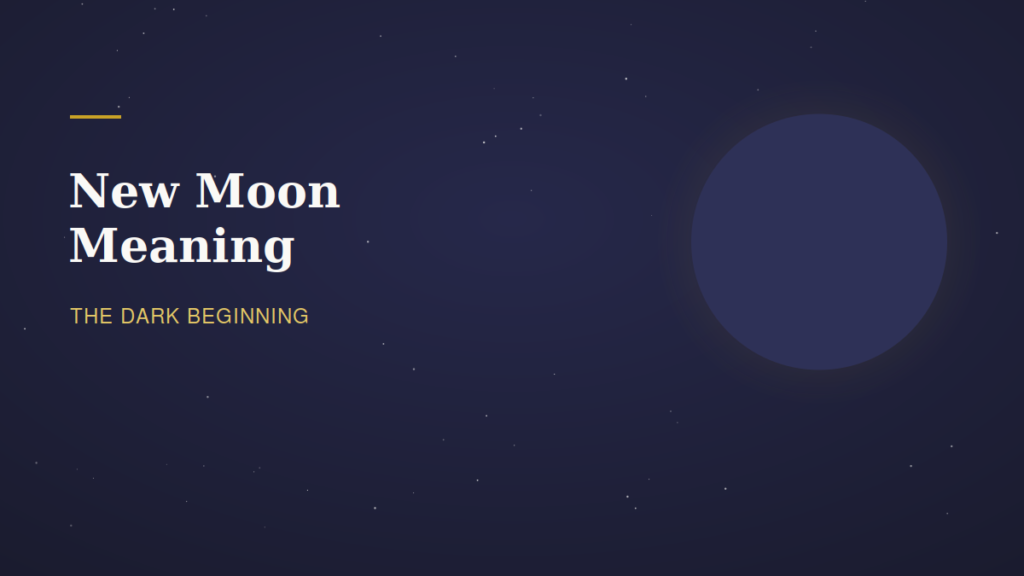
The new moon meaning spiritual traditions attach to it is almost universally about beginnings: the new moon is the darkest point of the cycle, when the Moon is invisible from Earth, and it is widely treated as a blank page — a moment for setting intentions before anything has taken shape yet.
Why the new moon is invisible
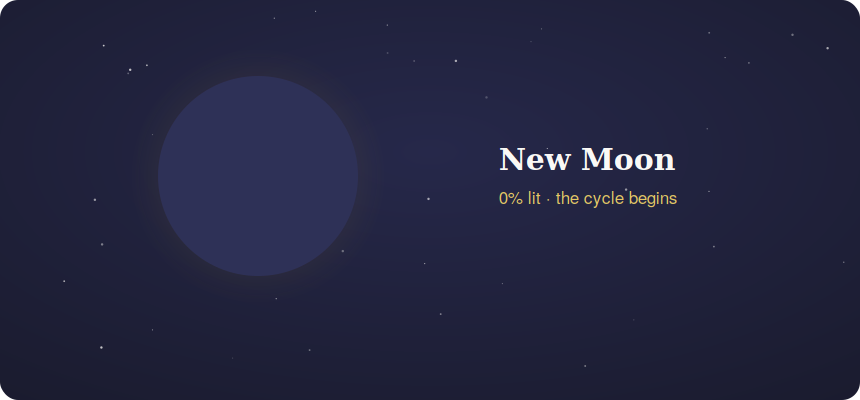
The astronomy is straightforward. At new moon, the Moon sits between Earth and the Sun, so the side lit by sunlight faces away from us and the side facing Earth is in shadow. NASA’s moon phases overview explains this geometry. The Moon has not gone anywhere — it is right there, simply unlit from our point of view.
Where it sits in the cycle
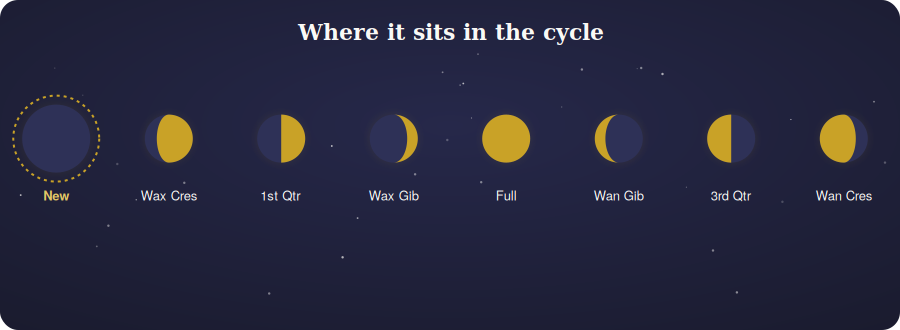
The new moon is phase one of eight, and everything else follows from it: waxing crescent, first quarter, waxing gibbous, full, waning gibbous, third quarter, waning crescent. Britannica’s lunar phases entry lays out the standard sequence.
New moon meaning spiritual traditions attach to it
In popular belief, the new moon is associated with:
- Fresh starts — the cycle resetting to zero.
- Setting intentions — naming what you want before it is visible.
- Planting seeds — effort that has not yet shown results.
- Rest and inwardness — the quiet before growth.
People born under a new moon are often described as self-starting, private, and comfortable beginning things without an audience.
An honest note: the meanings below are folklore and popular belief, not science. The astronomy is real and checkable; the symbolism is for entertainment.
Why the symbolism is so consistent
Worth noticing: the new moon’s associations are unusually consistent across cultures, and there is a plain reason. It genuinely is the start of the observable cycle, and it genuinely is dark. Symbolism built on “beginning” and “unseen” is not a coincidence — it is people describing what they could actually see, or rather what they could not. That does not make the personality readings true, but it does explain why they feel intuitive.
How long does the new moon last?
Technically it is an instant — the precise moment the Moon passes between Earth and Sun. In practice, the Moon is effectively invisible for a couple of days either side, since it is too close to the Sun in the sky to spot. That is why a new moon birthday covers a wider window than the astronomical moment suggests, and why plenty of people find their birth date lands in that dark stretch.
A genuinely dark sky
There is one practical benefit to the new moon that has nothing to do with symbolism: with no moonlight washing out the sky, it is by far the best time for stargazing. Faint objects like the Milky Way, meteor showers, and distant galaxies are dramatically easier to see. Amateur astronomers plan their observing nights around the new moon for exactly this reason, so if you have ever wanted to see a properly dark sky, that is the week to go looking.
New moon vs the thin crescent
These get confused. The new moon proper is invisible. What people often call a “new moon” in photos is really a young waxing crescent — the first sliver, a day or two later. In lunar calendars, it is that first crescent sighting, not the invisible moment, that traditionally starts a new month. timeanddate.com’s phases explainer covers the distinction.
Born under a new moon?
In moon phase compatibility, the new moon’s opposite is the full moon — the most talked-about pairing in the whole trend. Read new moon and full moon compatibility, or see all eight phases.
New moon meaning: a quick recap
To summarise: the new moon meaning spiritual traditions give it centres on beginnings, intention-setting, and quiet potential, matching a phase that is genuinely invisible and genuinely first. The astronomy is solid; the symbolism is folklore worth enjoying lightly.
Find your own phase
Find your birth moon phase — enter a birth date and see the phase in seconds. Free, no sign-up, and meant to be fun.
Then compare two birthdays and see how the phases pair up.